Turn your passion for football into a coaching career. CIMSPA-endorsed BSc with guaranteed professional placements and a pathway to your UEFA C coaching qualification.
Turn your passion for football into a coaching career. CIMSPA-endorsed BSc with guaranteed professional placements and a pathway to your UEFA C coaching qualification.
93% of students were satisfied with the teaching on this course (NSS, 2026).
Are you ready to turn your love of the game into a career? BSc (Hons) Football Coaching and Performance is built for aspiring coaches, performance analysts and player development specialists who want hands-on experience from day one. The course is endorsed by the Chartered Institute for the Management of Sport and Physical Activity (CIMSPA) and accredited by England Football as a Football Education Higher Education (FEHE) provider. You'll be taught by FA-qualified coach developers with years of experience delivering UEFA-accredited coaching courses.
On the pitch from day one: practical coaching sits alongside your academic study from your very first semester, so you build your coaching identity while you learn the theory behind it.
Develop your own coaching philosophy: across multiple modules you'll shape and articulate a personal coaching philosophy — a distinctive approach that helps you stand out to employers.
Learn from industry practitioners: your lecturers are UEFA-qualified coaches with experience ranging from grassroots to international football.
Choose your own path: a flexible final-year project lets you choose between a traditional dissertation or an applied innovation project, so you can showcase the strengths that matter most for your career.
Whether you want to coach at grassroots level, work in an academy, or move into performance analysis or sports event management, this course gives you the qualifications, experience and network to get there.
What's unique about this course?
What sets Wolverhampton apart is the depth of our football network and how early you're immersed in it.
Real West Midlands connections: we work with more than 50 clubs across the region, including key partners Wolverhampton Wanderers, West Bromwich Albion and Walsall FC, giving you access to placements, live projects and industry contacts most courses can't offer.
A clear qualifications pathway: alongside your degree, you'll work towards the FA Introduction to Coaching Football Award, Multiskills Level 2, your Hudl Level 1 performance analysis certificate, and the UEFA C coaching qualification (completion of these requires additional tasks outside the degree, alongside your regular coaching).
Coach abroad: our partnerships with Challenger Sports and Camp Americagive you the option to coach in the United States over summer, building international experience and a broader coaching network.
Small cohorts, real support: with a focus on personalised guidance, 100% of our students were satisfied with the teaching on this course, and 95% with the academic support available to them (NSS, 2025).
Genuinely inclusive coaching practice: our lecturing staff are practitioners in Equality, Diversity and Inclusion (EDI), with expertise spanning gender, race, disability and LGBTQ+ equality — so you'll learn to coach every kind of player and population, including disability football and the women's game.
What happens on the course?
This is a practice-led degree. From your first term, you'll be coaching on our 3G pitches as well as studying in the classroom, with each 12-week block building steadily from foundational theory through to hands-on application. You'll learn to plan, deliver and evaluate coaching sessions, analyse match performance using industry-standard software, and understand the sport science and tactical thinking behind the modern game.
Year one: you'll settle into university life, learn the fundamentals of coaching pedagogy, start using performance analysis technology (Hudl), and begin coaching in grassroots settings.
Year two: you'll develop your own coaching philosophy, examine tactical systems and playing styles, learn how to plan and deliver a sports event, and carry out your own research into talent identification and player development.
Year three: you'll take on advanced coaching and leadership challenges, solve real inclusive-coaching problems with diverse groups and populations, and complete an independent professional project in your chosen specialism.
Assessment mirrors what you'll actually do as a coach. You'll build a portfolio of coaching videos, performance analysis reports, presentations and reflective journals, rather than sitting traditional exams. Every module includes low-stakes practice opportunities and tutor feedback before anything counts towards your grade, so you can build confidence and refine your approach first.
Our Partners:
Placements on the course
We've built professional placements into every degree: every student on this course is guaranteed a professional placement. For a football coaching degree, that means real coaching hours in a professional environment, not just theory — giving you the CV evidence and industry contacts your career needs.
These short-term, structured experiences include:
Short duration: condensed, work-like experience in professional coaching or performance environments, including opportunities with our key partners Wolverhampton Wanderers, West Bromwich Albion and Walsall FC.
Academic integration: always linked to your coursework, assessments or professional development modules.
Project-based learning: you'll work on specific coaching, analysis or event-management tasks with a real organisation.
Flexible format: placements can be in-person, remote, hybrid or virtual.
Skill development: sharpens the workplace skills coaches need most, including communication, teamwork and problem-solving.
Experiential learning: closes the gap between what you've learned in the classroom and what you need to succeed on the pitch.
Employability on the course
Your future career starts on day one. You will benefit from:
Extended induction: a dedicated module to help you settle into university life and start building your coaching identity.
Structured learning pathways: each year builds towards specific football industry roles, from grassroots coaching through to performance analysis and sports management.
Hands-on project experience: real coaching sessions, live match analysis and genuine event-management projects, not simulated exercises.
Embedded professional development: workplace skills and placements are built into the course, not added on top.
Industry-informed modules: content is kept current through our club partnerships, staff research and direct industry experience.
Placement opportunities: a guaranteed professional placement for every student, including options with Wolverhampton Wanderers, West Bromwich Albion and Walsall FC.
Course Modules
Module:4SR062
Credits:30
Period:1
Type:Core
The module aims to introduce you to important football coaching principles used in different contexts and populations. It will encourage you to apply football-specific knowledge through thoughtful engagement in pedagogical practice, while developing an understanding of the nature of your role in enabling participant learning.
Module:4SR063
Credits:30
Period:1
Type:Core
This module establishes the theoretical foundation for effective coaching by exploring how people learn and develop in football contexts. You will examine pedagogical theories while developing essential professional skills including communication, session planning and developing a CV. This module introduces you to the role of the coach in a participatory football context. You will experience and examine the coaching process and acquire basic pedagogical skills through planning, delivering and evaluating sessions. You will also develop employability skills, where you will find a live job advert and then design a session plan and CV in relation to the chosen job role.
Module:4SR064
Credits:30
Period:1
Type:Core
This module will develop your analytical and scientific literacy essential for modern football coaching. This module bridges the gap between theoretical sport science and practical application, using technology and data to enhance coaching decision-making.
Module:4SR065
Credits:30
Period:1
Type:Core
This extended induction module supports your transition into university life and introduces you to football coaching principles. It helps you build confidence, develop a strong academic identity and understand the expectations of university study. You’ll explore key academic practices including independent learning, digital literacy and ethical academic conduct including referencing, plagiarism awareness and the responsible use of artificial intelligence in line with university policy. The module is structured around seven themes identified by students as essential to their university experience: Ready to Study: Clear guidance on expectations, transitions and workload planning. Academic Skills and Educational Gain: Development of foundational academic skills including time management, critical thinking, and digital fluency. Career Readiness and Professional Identity: Early exploration of career pathways, CV building and professional behaviours. Personal Development and Belonging: Activities that foster confidence, inclusion, and identity within the university community. Social Engagement and Community Building: Opportunities to connect with peers, staff, and wider university life. Feedback and Reflective Practice: Structured opportunities to receive, apply and reflect on feedback to support your growth as a student coach. Wellbeing and Student Support: Embedded access to holistic support services and strategies for success. This module lays the foundation for future professional development.
Module:5SR057
Credits:30
Period:2
Type:Core
This module develops your personal coaching philosophy while advancing your understanding of coaching methodologies. You will explore the relationship between individual coaching beliefs, values and practices, learning to articulate and implement a coherent philosophical approach to player and team development.
Module:5SR058
Credits:30
Period:2
Type:Core
This module develops your understanding of sports event management from grassroots tournaments to school competitions. You will develop planning, organisational and management skills essential for modern football coaching roles that increasingly require event coordination and administrative competence.
Module:5SR059
Credits:30
Period:2
Type:Core
In this module, you will examine how tactical approaches and playing styles reflect broader coaching philosophies. The module analyses contemporary tactical trends while developing understanding of how team philosophy shapes tactical implementation and player recruitment strategies.
Module:5SR060
Credits:30
Period:2
Type:Core
This research-focused module develops your critical understanding of the challenges inherent in talent identification systems within football. You will examine theoretical frameworks around relative age effect (RAE), biological maturation, chronological age, and psychosocial development while developing essential research skills for independent investigation. Through collecting and analysing real data from football environments, you will gain practical experience in mixed methods research approaches that prepare you for Level 6 dissertation work. The module bridges theory and practice by engaging in authentic research that has direct implications for coaching practice and player development systems. You are expected to critically evaluate current talent identification approaches, recognise inherent biases and limitations, and develop evidence-based perspectives on creating more equitable and effective player development pathways.
Module:6SR056
Credits:30
Period:3
Type:Core
This advanced coaching module develops you into a reflective practitioner and leader capable of driving innovation in football coaching. You will integrate all previous learning while developing advanced coaching competencies, leadership skills and the ability to mentor other coaches.
Module:6SR054
Credits:30
Period:3
Type:Core
This module develops your capability to coach diverse populations while solving complex problems in real coaching environments. You will demonstrate advanced coaching competencies through practical problem-solving scenarios that require adaptation to different groups, abilities and contexts. You will work as a group with your peers to solve a real-world coaching problem that exists within your coaching context, using evidence-based research and theory to identify solutions to address the problem and make your coaching more inclusive.
Module:6SR060
Credits:30
Period:3
Type:Core
This module provides you with the opportunity to complete a short, independent professional project within your chosen subject area, supported by the guidance of an academic supervisor. You will investigate a topic relevant to your degree pathway, drawing on appropriate research, theory, and professional evidence to deepen your understanding and inform your project work. A range of topic areas that can be investigated will be provided for you, and you will choose one to focus your professional project on. Depending on your academic discipline, your project may take the form of an applied investigation, evaluation, resource development, intervention design, or practice-based study. Throughout the process, you will be expected to plan and manage your work independently, demonstrating initiative, organisation, and critical thinking. You will engage in regular supervisory meetings to receive feedback, refine your ideas, and ensure your project is academically robust, ethically sound, and professionally relevant. Reflection is embedded across the module, enabling you to evaluate your decision-making, professional conduct, and the impact of your work. By completing this module, you will consolidate your subject knowledge, strengthen your research and project management skills, and demonstrate your readiness for graduate-level employment or further study across sport, health, education, and exercise-related professions.
Module:6SR055
Credits:30
Period:3
Type:Core
This module prepares you for coaching and management roles by developing strategic thinking, problem-solving and leadership capabilities. You will address the challenges that organisations in the football industry face when recruiting for graduate level roles.
Additional Information
Everything you need to know about this course!
This course is backed by the same facilities, funding and record of graduate success as the rest of our sport courses.
99% sports graduate employability. Our students get jobs (Destination of Leavers from Higher Education survey).
Free university-branded sports kit for all students in their first year.
Specialist facilities, including human performance and movement labs with an environmental chamber and 3D motion capture, physiotherapy and sports therapy suites, an elite strength and conditioning suite, a multi-million-pound Sports Centre and a 3G football pitch.
Sports Scholarships worth up to £4,500 across a three-year degree (subject to a successful application).
Inspirational teaching staff who are practitioners and researchers in their field, working alongside our WLV Sport teams.
An innovative block curriculum, including dedicated modules to introduce you to higher education and build your employability from year one.
By graduation, you'll have a genuinely broad skill set covering the theory, practice and business of football coaching. You'll be able to:
Apply a systematic understanding of coaching theory, pedagogy and performance principles, including current tactical systems and sport science.
Design, deliver and evaluate coaching interventions for a wide range of players, contexts and abilities.
Use research methods and analytical techniques to investigate real coaching and performance problems.
Read and interpret performance data using industry-standard analysis software, including Hudl.
Critically evaluate coaching practice and communicate your judgements clearly to players, coaches and organisations.
Lead, mentor and take professional responsibility in complex, real-world coaching environments.
Articulate your own coaching philosophy and professional capabilities through a portfolio built for the job market.
Alongside your degree, you'll also work towards the
By graduation, you'll have a genuinely broad skill set covering the theory, practice and business of football coaching. You'll be able to:
Apply a systematic understanding of coaching theory, pedagogy and performance principles, including current tactical systems and sport science.
Design, deliver and evaluate coaching interventions for a wide range of players, contexts and abilities.
Use research methods and analytical techniques to investigate real coaching and performance problems.
Read and interpret performance data using industry-standard analysis software, including Hudl.
Critically evaluate coaching practice and communicate your judgements clearly to players, coaches and organisations.
Lead, mentor and take professional responsibility in complex, real-world coaching environments.
Articulate your own coaching philosophy and professional capabilities through a portfolio built for the job market.
Alongside your degree, you'll also work towards the FA Introduction to Coaching Football Award, Multiskills Level 2 Award, Hudl Level 1 certificate and the UEFA C coaching qualification. N.B. completing these qualifications requires some additional tasks outside of the degree programme, alongside your regular coaching.
Multiskills Level 2 Award, Hudl Level 1 certificate and the UEFA C coaching qualification. N.B. completing these qualifications requires some additional tasks outside of the degree programme, alongside your regular coaching.
The University will fund an initial enhanced DBS check (where your course requires) GOV.UK / Disclosure and Barring Service. Some placement settings will require a refreshed certificate every 12 months. You are therefore encouraged to register for the Update Service within 30 days of the certificate being issued. This costs £13 per year and you can pay by debit or credit card.
Uniform is provided for this course, however the University of Wolverhampton reserves the right to make a charge.
You will be required to provide appropriate foot wear at a cost of approximately £50-£60
Optional Costs
Various Sporting professional body memberships *prices will vary depending on body.
Various industry standard courses are available via the School of Sport's Earn and Learn employability initiative. You may be asked to contribute £0 - £200 toward these.
Further information on these additional costs will be provided prior to the start of your studies
The University is committed to a transparent fee structure, with no hidden costs, to help you make an informed decision. This includes information on what is included in the fee and how fees are calculated and reviewed.
If a tuition fee is not showing, we may not offer this intake for this course. Please check the start date information on the course finder for start dates.
# Undergraduate part-time fees for 50% rate of study
Entry to this course requires a Disclosure and Barring Service (DBS) Check and an Occupational Health Check.
Free Disclosure and Barring Service (DBS) and Occupational Health Check:
Due to the professional nature of some of our courses you may also be required to complete a Declaration of Health and Disclosure and Barring Service (DBS) Check. We will coordinate both of these non-academic conditions with you should your course require this and you receive an offer from us
There will be no cost for the DBS this is free to applicants who have secured an offer and have chosen to study at the University of Wolverhampton.
Students must usually have studied for a minimum of two years post GCSE level. However, we will consider applications from mature students who do not have two years of post-16 study, where they have relevant work experience. Please see http://wlv.ac.uk/mature for further information.
Ibrahim Diallo - Second Year Student
"My name is Ibrahim Diallo and I'm currently in my second year studying Football Coaching and Performance at Wolverhampton. I've always been a huge fan of football and had a passion for the sport. I was fascinated by how a football coach deals with players and how they approach sessions on a day-to-day basis.
My time of study at university has been very interesting because I have met good people and have the right support group around me. The balance between learning in the classroom and learning in a practical element is really good because it helps me as a coach to understand how to apply techniques to my sessions and develop. The classroom work is vital because as a student you can research different articles for your assignments. I like how the timetable flows - in the morning we're in the classroom and then after lunch we're on the astro doing practical work, which makes the lessons more engaging.
A real turning point for me was the sports coaching and pedagogy module, where I had to do a presentation regarding my sessions over the weeks. That's where I learned the different types of coaching techniques that I can apply as a coach and reflect on what I can improve on.
I'm currently working with a grassroots team called TT Elite. I started as a volunteer and used this to learn about other coaches and see how they deal with the players they're coaching. I see what makes other coaches stand out and try to add that to my own coaching. I've enjoyed it because it has really helped me understand that if you want to make it as a coach, you must have a certain level of commitment and make huge sacrifices. What I'm learning is that as a coach you must be adaptable because the session might not go as planned, so I make sure I have a backup plan so the session flows without any major distractions.
The teaching staff have supported me massively with my assignments, giving me really good feedback. They've also supported me with extra qualifications like the multi-sport certification, which can help me with getting a job at school. The most valuable connections I'm making are with coaches that work in an academy or professional setting. These connections are valuable because they can lead me to get an opportunity to coach at a good level and help me learn about their journeys.
Since coming to the university, I've always enjoyed using the astro turf for the practical side of the course. I'm doing what I like, which is playing football, so using the facilities has been good. The size of the classrooms are at a good standard and the computers I've had to use for the analysis module were really impressive - there were features I didn't know you could use.
Where I see myself in five years is working in an academy setting or in other departments in the football field. I'm confident that this course is helping me out, so I have to make sure that I make the most of it - if not, then I only have myself to blame for not being proactive."
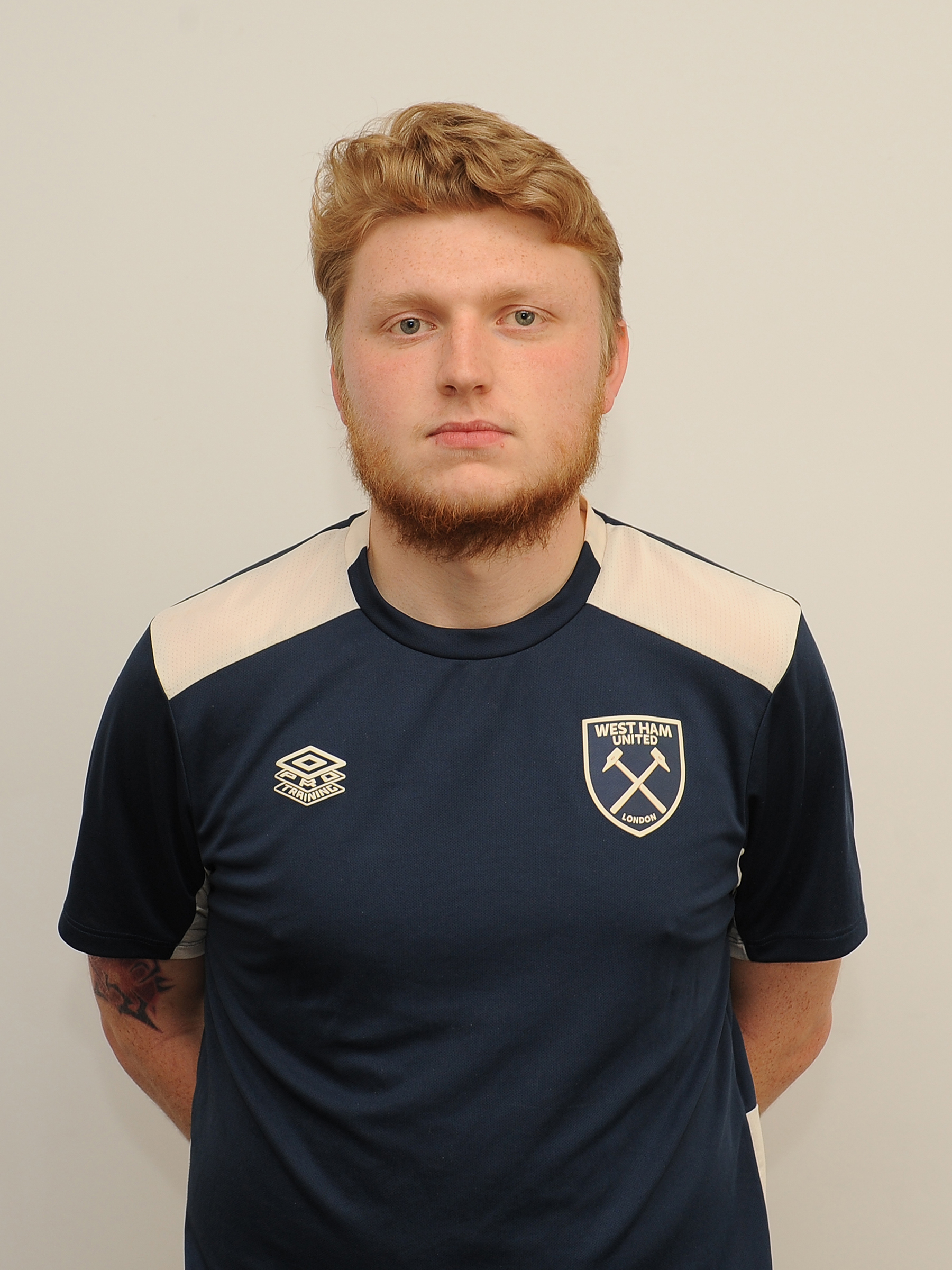
"During my second module in first year, I was introduced to analysis software and I really enjoyed looking at football in this way - that's when I realised I wanted a career as an analyst.
My lecturer Martin was a big factor in this motivation. He made me aware of analyst placement opportunities at different clubs and recommended me to apply, which led to what I'm doing now. This placement at West Ham, working inside a Category 1 academy environment with professional analysts and coaches, is probably the best opportunity I've received from this course.
The teaching staff are really supportive and more than willing to help students develop and get great opportunities. It has felt amazing and very rewarding putting the skills I learnt at uni into practice and being able to develop them further."
Gage Badger, 2nd Year Student on Placement, BSc (Hons) Football Coaching and Performance Currently on Placement at West Ham United Academy
Here is one of our 2024 graduates, Tom Wilkes, who is now working for Aston Villa Football club, as well as running a successful coaching business:
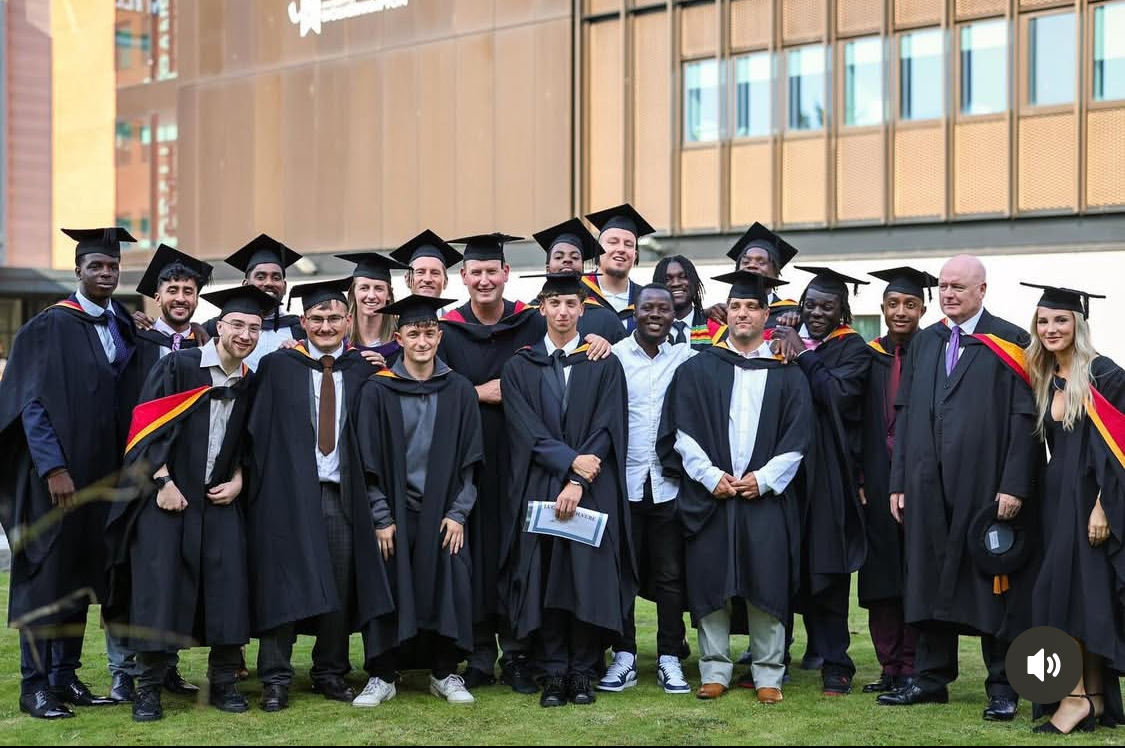
Graduation photos
Chartered Institute for the Management of Sport and Physical Activity (CIMSPA)
Endorsed by the Chartered Institute for the Management of Sport and Physical Activity (CIMSPA).
Most students will be able to apply for a loans to pay for these subject to eligibility. To find out more information please refer to the government Student Finance website.
Changes for EU students:
The UK government has confirmed that EU students starting courses from 1 August 2021 will normally be classified as having Overseas Fee status. More information about the change is available at UKCISA:
EU citizens living in the UK with 'settled' status, and Irish nationals living in the UK or Ireland, will still be classified as Home students, providing they meet the usual residency requirements, for more information about EU Settlement Scheme (EUSS)
Self-funding:
If you don’t want to take out a loan to pay your fees or if you aren’t eligible to receive a loan, you might want to take advantage of the University’s scheme to pay by instalments: See How to pay.
Your employer, embassy or organisation can pay for your Tuition fees:
If your employer, embassy or organisation agrees to pay all or part of your tuition fees; the University will refer to them as your sponsor and will invoice them for the appropriate amount.
We must receive notification of sponsorship in writing as soon as possible, and before enrolment, confirming that the sponsor will pay your tuition fees.


/prod01/wlvacuk/media/departments/digital-content-and-communications/images-2026/Claire-Macdonald-graduate---courtyard-2-wolf-resized.jpg)
/prod01/wlvacuk/media/departments/digital-content-and-communications/submitted-news-images/nss2026_800x400-1.jpg)
/prod01/wlvacuk/media/departments/digital-content-and-communications/CTU-2.jpg)
/prod01/wlvacuk/media/departments/digital-content-and-communications/submitted-news-images/Indian-weightlifting-team.JPG)
/prod01/wlvacuk/media/departments/digital-content-and-communications/Adopting-AI-for-Business.jpg)
/prod01/wlvacuk/media/departments/digital-content-and-communications/submitted-news-images/54505138639_670536a9d0_c.jpg)
.jpg)


.jpg)



.jpg)