School of Health and Wellbeing

BSc (Hons) Paramedic Science with Foundation Year

BSc (Hons) Full-time 4 years

This full-time course is designed to equip students with the essential knowledge, practical skills and professional behaviours for a rewarding and lifelong career as a Paramedic. 

This full-time course is designed to equip students with the essential knowledge, practical skills and professional behaviours for a rewarding and lifelong career as a Paramedic. 

Award
BSc (Hons)
Start date(s)
13 September 2027
UCAS Code
B952
Course specifications
Course length
Full-time (4 years)
Campus location
University: Walsall Campus
UCAS points calculator

Why choose this course?

15th for Health Professions in the UK (The Guardian University Guide 2027)

This 4-year full-time course is designed to equip students with the essential knowledge, practical skills and professional behaviours for a rewarding and lifelong career as a Paramedic. However, this 4-year programme also includes a Foundation Year which has a focus upon developing the key academic skills necessary for successful completion of the programme. These academic skills include academic writing, referencing and presentation skills and this course of study is targeted towards those applicants that might have been out of the education system for some time, or might have just fallen slightly short of the UCAS tariff for our 3-year programme. This BSc (Hons) Paramedic Science with Foundation Year widens participation into the profession and upon successful completion of this Foundation Year, students will progress seamlessly onto year 1 of our 3-year programme.   

The University of Wolverhampton has been providing undergraduate Paramedic Science programmes since 2014 and you will be taught not only by Paramedics, but also by other subject matter experts (E.g. Midwives). We are a passionate and highly experienced teaching team who are ready to prepare you for a career as a Paramedic.  

The course is fully accredited by the Health and Care Professions Council (HCPC) and is run in partnership with West Midlands Ambulance Service. Once you have successfully completed the first year of this programme, you will be allocated an experienced mentor, and you will undertake supernumerary shifts responding to 999 calls across the region. This will give you the opportunity to assess and treat patients whilst being supported by a qualified clinician. You may also have the opportunity to undertake a specialist placement in a setting such as the emergency department, operating theatre, coronary care unit, maternity unit, minor injury unit or a healthcare facility within a prison. Please not that the BSc (Hons) Paramedic Science with Foundation Year does not include any clinical practice placements in the first year of study. This year is primarily a foundational year to support students in their transition from school/college or the workplace into a higher education setting. 

Throughout your journey, you will undertake theory modules to provide you with the foundational knowledge and academic skills required to function as a contemporary Allied Health Professional. From year two onwards, you will also spend lots of time in our state-of-the-art clinical skills labs learning the practical skills necessary to work as a Paramedic. We utilise our SUCCESS (Service User and Carer Involvement) team to aid clinical skills teaching and they have real life experience of accessing emergency care and enable you to understand the patient’s perspective. 

We are incredibly proud of our diverse cohorts who come to the university from a variety of backgrounds and bring with them a wealth of experience. We particularly welcome applications from mature applicants, those who may have been out of education for a while, and individuals from under-represented groups. Our course operates a guaranteed interview scheme, and we will guarantee an interview to all applicants who meet our minimum entry requirements and UCAS tariff. Once qualified, our Graduate Paramedics are highly sought after by employers, and whilst many choose to join an NHS ambulance service when they graduate, other options may be available to you.  
What's unique about this course?

  • Our Foundation Year programme has been designed to prepare you for studying at undergraduate level and provide you with the required skills and knowledge to transition effectively into Level 4 study
  • You will be taught not only by Paramedics but also by other subject matter experts (e.g. Midwives). We are a passionate and highly experienced teaching team who are ready to prepare you for a career as a Paramedic. 
  • You may also have the opportunity to undertake a specialist placement in a setting such as the emergency department, operating theatre, coronary care unit, maternity unit, minor injury unit or a healthcare facility within a prison.

What happens on the course?

This is an academically challenging and rigorous full-time course of study leading to professional registration with the Health and Care Professions Council (HCPC). In each year, students will study 6 modules which cover the key areas of Paramedic Science. Each module is assessed, and assessments include traditional examinations, assignments, presentations, Vivas and Objective Structured Clinical Examinations (OSCE’s). Students are expected to be on campus up to 5 days a week (09:00-16:00) and teaching will be centred around lectures, group work and independent study and in the final 3 years of the programme, students will be involved in clinical simulations. 

From year two onwards, students will also undertake supernumerary shifts with West Midlands Ambulance Service, and you will work alongside your mentor to complete a Practice Assessment Document (PAD) which includes a variety of core competencies. You may be expected to travel up to 1 hour away from your term time address to access these placements and students undertake either a 12-hour day shift (E.g. 06:00-18:00) or a 12-hour night shift (E.g. 18:00-06:00). Weekend working should also be expected during your clinical practice placements. A driving license is not a pre-requisite for entry to our programme, but applicants should carefully consider how they plan to travel to placement and how they will manage their time and family commitments during the course. 

This is a challenging programme of study but there is lots of support for students throughout your time with us. Students will be allocated a personal tutor, an academic coach and you will have access to our library and learning facilities. For those students who require additional support (E.g. Dyslexia), reasonable adjustments will be made. The University of Wolverhampton is a fantastic choice for anyone considering a career as a Paramedic! 

Placements on the course

Placements on the course

Placements are a core part of this course, giving you hands-on experience with the West Midlands Ambulance Service University NHS Foundation Trust (WMAS), and exposing you to a wide range of patients and the realities of out-of-hospital care.

Your Foundation Year doesn't include placements. The Foundation Year is primarily focused on transition, confidence-building and professional identity formation, helping you move from school, college or the workplace into higher education. Clinical practice placements start once you progress into Level 4.

From Level 4, placements build gradually:

  • Your first clinical placement blocks with WMAS begin during your Foundations of Paramedic Assessment and Management module, alongside preparation in simulation.
  • Once you've successfully completed your first year of clinical study, you'll be allocated an experienced mentor and undertake supernumerary shifts responding to 999 calls across the region, assessing and treating patients under supervision.
  • In years two and three, you'll also have the opportunity to experience how urgent and emergency care is delivered in non-ambulance settings, such as GP surgeries, maternity units, emergency departments, operating theatres, prisons, palliative care and mental health services. Specialist settings can include the emergency department, operating theatre, coronary care unit, maternity unit, minor injury unit or a healthcare facility within a prison.
  • Additional opportunities can include joint training exercises with prehospital care providers such as the Midlands Air Ambulance and West Midlands Care Team.
  • Each year concludes with an extended placement designed to consolidate learning and build confidence through immersive clinical experience.

What placement shifts look like
You'll undertake either a 12-hour day shift (for example, 06:00–18:00) or a 12-hour night shift (for example, 18:00–06:00), and weekend working should be expected during clinical practice placements. You may need to travel up to an hour from your term-time address to reach placements, so it's worth thinking ahead about transport and how you'll manage time and family commitments during the course. A driving licence isn't a requirement for entry.

Support while you're on placement

  • A named mentor supervises and supports you throughout your placement shifts
  • You'll complete a Practice Assessment Document (PAD), covering a variety of core competencies, with your mentor confirming your proficiency each year
  • Before each placement, simulation-based learning gives you structured opportunities to practise clinical reasoning and decision-making in realistic scenarios first
  • Service users and carers, through the University's SUCCESS team, contribute to clinical skills teaching and act as simulated patients, helping you understand the patient's perspective before you go into practice
  • You'll also engage in interprofessional education alongside students from other health disciplines, including physiotherapy, podiatry, occupational therapy and midwifery, to understand collaborative, multiprofessional care

Meeting professional requirements
Placements are assessed through the achievement of clinical competencies, tracked in your Practice Assessment Document. Attendance and engagement must reach 80% of planned programme hours across both theory and clinical practice, in line with HCPC requirements. There's no automatic right to compensation on any module at Levels 4, 5 or 6, and students are ordinarily required to pass all 120 credits to progress, though individual exceptions may be considered — for example, where a student hasn't completed their PAD due to external factors but is clearly on track to pass.

Employability on the course

Our courses are designed from day one to prepare you for your future career. You will benefit from:

  • Extended induction: a period to familiarise yourself with your new university
  • Structured learning pathways: courses are crafted with a focus on preparing students for future careers
  • Hands-on project experience: projects and practical activities designed around real-world activities
  • Embedded professional development: all courses are designed with workplace skills development and professional placements as part of the course
  • Industry-informed modules: course content is kept up-to-date with industry standards through our industry links, staff's research and work in the field
  • Placement opportunities: professional development placements for every student

Course Modules

Potential Career Paths

Upon successful completion of this course, you will be able to apply for registration as a Paramedic with the Health and Care Professions Council (HCPC). Registration creates opportunities in an increasingly diverse range of areas and many of our recent graduates have successfully applied for the following roles: 

With further training and clinical experience, you could also apply for the following leadership, educational or advanced practice roles: 

  • HEMS (Helicopter Emergency Medical Service) Paramedic 
  • Critical Care Practitioner (CCP) 
  • Advanced Clinical Practitioner (ACP) 
  • Resuscitation Officer, Senior Resuscitation Officer, Head of Resuscitation 
  • Primary Care Paramedic (GP Surgery) 
  • Research Paramedic 
  • Operational Manager 
  • Clinical Team Mentor (CTM) 
  • Education and Training Officer 
  • Lecturer/Senior Lecturer in Paramedic Science 

Increasingly, some Paramedics are choosing to continue their studies with a master’s degree and/or PhD and some Paramedics have opted to work abroad. Recent destinations have included: Australia, New Zealand, Canada, USA, Saudi Arabia and the United Arab Emirates.  

Additional Information

Everything you need to know about this course!

This academically challenging and rigorous programme of study will give graduates a solid grounding in all the skills necessary to apply for registration as a Paramedic with the Health and Care Professions Council (HCPC). Students will be taught all the clinical skills necessary to function as a Newly Qualified Paramedic (NQP) and these will be taught alongside academic skills such as academic writing, referencing and critical thinking that are necessary for a modern Allied Health Professional. Skills that are highly valued by employers across a rage of sectors will be incorporated throughout. These include: 

  • Communication  
  • Critical thinking 
  • Digital literacy 
  • Leadership 
  • Problem solving 
  • Project management  
  • Team working 
  • Time management 

Location Mode Foundation Year Fee Sep intake Fee Year
Home Full-time £9790 £9790 per year 2026-27
International Full-time £17600 £17600 per year 2026-27

The University is committed to a transparent fee structure, with no hidden costs, to help you make an informed decision. This includes information on what is included in the fee and how fees are calculated and reviewed.


If a tuition fee is not showing, we may not offer this intake for this course. Please check the start date information on the course finder for start dates.

Prepare for foundation pathway: 

Applicants who wish to access this course will be required to attend and pass a compulsory one day Prepare for foundation programme. This programme is where you will be able to showcase your keen interest or recent experience in the subject. As well as come to visit the university and meet the staff involved in the programme.

This compulsory programme is designed to introduce you to studying a health professional course, answer your questions, meet staff and fellow students. You will take part in a variety of exciting subject related activities that will prepare you to kick start your academic experience with us, should you secure an offer. 

Before attending the Prepare for foundation programme, we wish to make you aware that you will be asked to complete an assessment task which will be used as part of the event. Further information on the requirements of this task will be provided to applicants who have been shortlisted for this course.

Interview: 

If you are successful in passing this programme, you will be required to attend an interview with faculty staff.

GCSE requirements:

You are required to hold GCSE English language and maths grades 9-4/A*-C or equivalent. Equivalent qualifications include the following at Level 2: Functional Skills, Key Skills, Learn direct.

Equivalency Test:

If you have not achieved your Level 2 qualifications, you are eligible to take our University equivalency tests. The tests for this course are free of charge and can be taken completely online. Our Admissions team will confirm in your offer if you are required to take one of these assessments.

Free Disclosure and Barring Service (DBS) and Occupational Health Check:

Due to the professional nature of some of our courses you may also be required to complete a Declaration of Health and Disclosure and Barring Service (DBS) Check.  We will coordinate both of these non-academic conditions with you should your course require this and you receive an offer from us

There will be no cost for the DBS this is free to applicants who have secured an offer and have chosen to study at the University of Wolverhampton.

Student Visa Requirements:

Applicants who require a student visa to enter the UK are not eligible to be considered for this course. 

Skilled Worker Visa Requirements:

Applicants who are in the UK on a Skilled Worker Visa or are a dependent of a Skilled worker are not eligible to be considered for this course. 

Other Requirements: Applicants must be 18 years old or above at the start of the course.

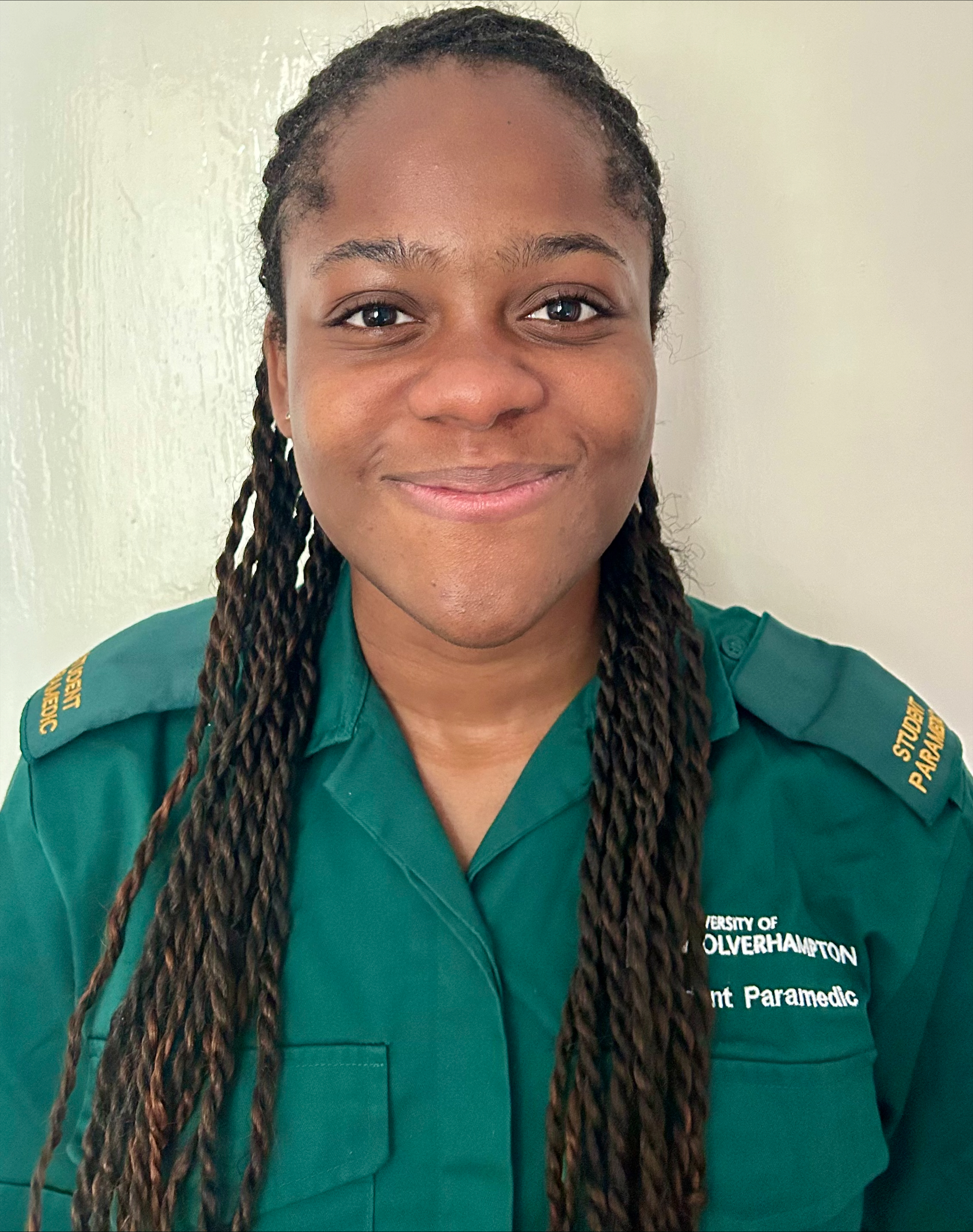
"This course continuously develops our skills in a pace that is manageable and allows us to enjoy what we're doing. The lecturers are very approachable and are on hand to help us wherever they can. I absolutely love this course!" - Esther Gameklu


Student Esther in Paramedic Science uniform smiling

"Health and Care Professions Council, the (HCPC)"

Approved by the Health and Care Professions Council (HCPC) for the purpose of providing eligibility to apply for registration with the HCPC as a paramedic.

Tuition Fees Loan (Home Fee Status):

Most students will be able to apply for a loans to pay for these subject to eligibility. To find out more information please refer to the government Student Finance website.

Changes for EU students:

The UK government has confirmed that EU students starting courses from 1 August 2021 will normally be classified as having Overseas Fee status. More information about the change is available at UKCISA:

EU citizens living in the UK with 'settled' status, and Irish nationals living in the UK or Ireland, will still be classified as Home students, providing they meet the usual residency requirements, for more information about EU Settlement Scheme (EUSS)


Self-funding:

If you don’t want to take out a loan to pay your fees or if you aren’t eligible to receive a loan, you might want to take advantage of the University’s scheme to pay by instalments: See How to pay.

For more information please contact the Gateway.


Your employer, embassy or organisation can pay for your Tuition fees:

If your employer, embassy or organisation agrees to pay all or part of your tuition fees; the University will refer to them as your sponsor and will invoice them for the appropriate amount.

We must receive notification of sponsorship in writing as soon as possible, and before enrolment, confirming that the sponsor will pay your tuition fees.


Financial Hardship:

Students can apply to the Dennis Turner Opportunity Fund.

for help with course related costs however this cannot be used for fees or to cover general living costs.


Bursaries and Scholarships:

In addition the University also offers a range of Bursaries and Scholarships packages

You can find more information on the University’s Funding, cost, fee and support pages.

Telephone

01902 32 22 22

Email

enquiries@wlv.ac.uk

Online

Order a prospectus

How we compare

Find out how our course is rated on Discover Uni, the official website for comparing UK higher education courses.

Find out how our course is rated on Discover Uni, the official website for comparing UK higher education courses.

Full-time Course